
Resources
What Actually Happens During a Colonic, Step by Step
Reviewed by our qualified colonic hydrotherapists , naturopaths and allied health practitioners, including ATMS, ANTA and MAA members
Last updated
The most common reason people put off booking a colonic isn’t cost or scepticism. It’s not knowing what they’re walking into.
A colonic, short for colonic irrigation, gently flushes the large bowel with warm, filtered water through a small single-use tube, filling and releasing in cycles over about 30 to 40 minutes.
So here is the whole thing, start to finish, with nothing skipped. This is how a colonic runs at our Brunswick West clinic; other clinics differ, sometimes in ways worth asking about.
Before you arrive
Once your appointment is confirmed you’ll get an email covering how to prepare, what to eat and avoid beforehand, and how to hydrate in the lead-up. It’s worth following, mostly because hydration makes a real difference to what happens on the day.
Wear loose, comfortable clothing. Bring a list of any medications and supplements, and details of relevant diagnoses or recent procedures.
Eat a light meal 2 to 4 hours beforehand. Don’t fast, arriving on an empty stomach makes light-headedness more likely and doesn’t improve anything.
Arriving
You’ll be greeted at reception and given a medical history form if it’s your first visit. Allow 10 to 15 minutes extra for this.
The form asks about your digestive history, medications, surgeries, diagnoses and current symptoms. It matters. It’s how your practitioner rules out the conditions that make treatment inappropriate, some of which aren’t obviously related to digestion.
The consultation
Your practitioner takes you through to a private room and goes through your history properly, rather than glancing at the form.
This is the point to raise anything you’re uncertain or self-conscious about. Every practitioner here has heard it before, and it’s a better conversation now than mid-session.
They’ll explain what’s about to happen, how the equipment works, and what you’ll feel. If anything in your history means it isn’t appropriate today, this is where that gets identified, and we’d rather stop here than proceed.
Getting ready
Your practitioner leaves the room. You undress from the waist down, in private, and lie on the treatment table covered with a modesty sheet. Your top half stays clothed throughout.
There’s an ensuite attached to the room, so you’re not going anywhere or passing anyone.
The tube
Your practitioner returns, talks you through it, and places a small single-use tube. Actual exposure is a matter of seconds, and you’re covered before and after.
This is the part people dread most beforehand and consistently describe afterwards as an anticlimax. It’s a small tube, it’s over quickly, and it isn’t painful.
The session itself
Roughly 30 to 40 minutes, working as a repeated cycle:
- Warm filtered water gently fills the colon
- It’s held briefly, this is where you feel fullness
- It releases through the sealed waste line, carrying waste with it
- Repeat
Over the whole session that adds up to 40 to 60 litres, but only a small volume is ever in you at once. The colon comfortably holds a couple of litres, and the total is just the sum of many cycles.
What you’ll feel
Fullness, in waves. Rising as it fills, easing as it releases. Odd at first, then unremarkable.
Occasional mild cramping during release. It passes in seconds and it’s a normal muscular response, not a sign anything is wrong.
Warmth. Water is held near body temperature, cold water causes cramping, and too warm is unsafe.
Your practitioner is adjusting flow, pressure and temperature the whole time, and checking in. If something is uncomfortable, say so and it gets changed. You’re not enduring a fixed program.
The massage
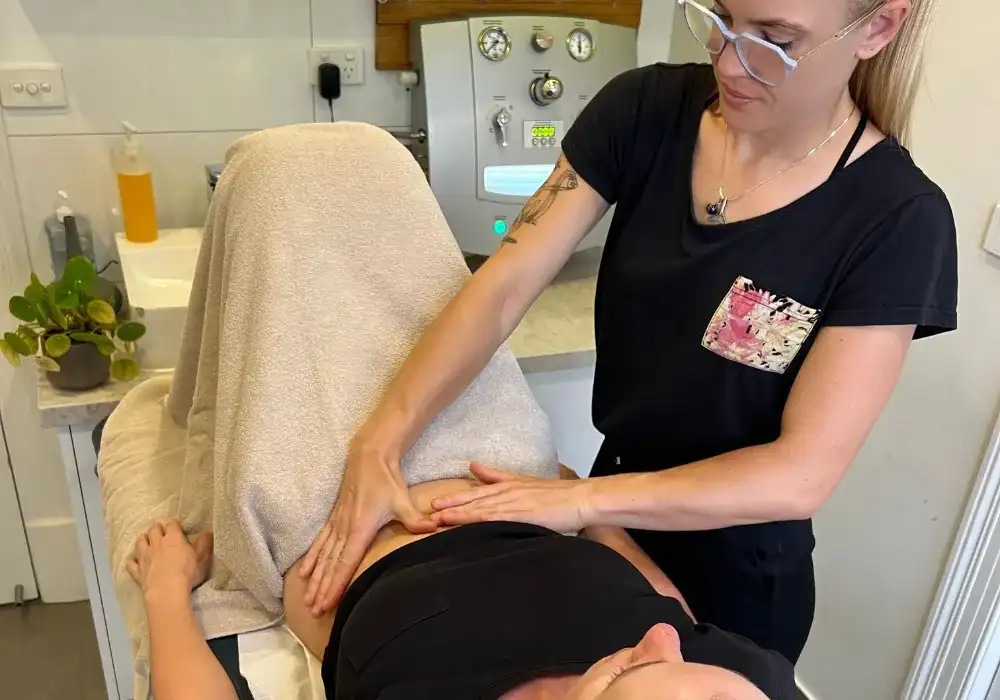
Many practitioners use gentle abdominal massage during the session, which helps move trapped gas and encourages release. If you’d rather not, say so.
The viewing tube
Because it’s a closed system, there’s a viewing section in the line, and your practitioner can talk you through what’s passing, stool consistency, gas patterns, signs of dehydration or undigested food.
Some people want the running commentary; others would rather not know. Both are fine, just say which.
You won’t be told you have parasites. We don’t diagnose parasites by sight, because it isn’t possible, and it’s a tactic used elsewhere to sell ongoing treatment.
The ensuite
When the machine part finishes, you’ll spend 20 to 30 minutes in the attached ensuite. Your body continues evacuating naturally, and this time is built in deliberately.
It’s the reason you don’t leave feeling any urgency. There’s a shower, and you can take the time you need.
Aftercare
Your practitioner talks through what to expect over the next few days, hydration, what to eat, what’s normal, and what isn’t. If it’s worth a follow-up session they’ll say so and explain why; if it isn’t, they’ll say that too.
No package will be pushed on you. If someone is pressuring you into a course of treatment at a first visit, at any clinic, that’s a reason to be sceptical.
Leaving
Many people describe feeling lighter afterwards. Some feel a little tired, particularly after a first session.
Nearly everyone drives themselves home and gets on with their day. If it’s your first time, it’s worth not scheduling anything demanding immediately afterwards, not because you’ll be incapacitated, but because it’s more pleasant not to rush.
The bit nobody mentions
You may not have a bowel movement for a couple of days afterwards. This is normal, expected, and the single most common reason people ring us afterwards.
A colonic empties the bowel far more thoroughly than a normal movement, so there’s little to pass until you’ve eaten enough for waste to accumulate again. Up to about five days is within normal range.
Still uneasy?
That’s reasonable, and common. You’re welcome to ring us and ask before you commit to anything, no booking required, no pressure, specifically so you can ask the questions that are easier to ask on the phone than in person. Our clinic team have heard every one of them, and if it’s something only a practitioner should answer, one of them takes it.
Call us on 03 9388 0080. Not ready to call? Drop us a line and tell us what you need help with, or read our full FAQ.
Frequently asked questions
What happens during a colonic session?
After a health screening, you change from the waist down in private and lie covered on a treatment table. A small tube is placed, then warm filtered water gently fills and releases in cycles for around 30 to 40 minutes while your practitioner adjusts flow and temperature. You then have 20 to 30 minutes in the ensuite as your body finishes evacuating naturally.
How long does a first colonic appointment take?
Allow around 75 minutes for a first visit, roughly 10 to 15 minutes for screening and consultation, 30 to 40 minutes on the machine, and 20 to 30 minutes in the ensuite afterwards. Returning sessions are closer to 60 minutes.
Is the practitioner in the room the whole time?
Yes, because the treatment is being adjusted continuously rather than run at one setting. Water flow, pressure and temperature are dialled to how your body is responding, and gentle abdominal massage is used where it helps release. In an open system nothing is tailored: you operate the equipment yourself at whatever pressure the gravity feed gives you. That's the difference with a closed system: the session is adjusted to you as it runs.
What does a colonic feel like?
Mostly a sensation of fullness, coming and going in waves as the water fills and releases. Occasional mild cramping is normal during the release phase and passes quickly. Most people find the first few minutes strange rather than painful, and are surprised by how ordinary it feels after that.
Will I need to rush to the toilet afterwards?
No. The ensuite time at the end of the session is specifically so your body can finish evacuating before you leave, which is why you shouldn't feel any urgency on the way home. Most people drive themselves and return to normal activities straight away.
Ready to book your appointment?
No referral needed. Book online 24/7, or call reception.
Still weighing it up?