
Resources
Closed vs Open Colonic Irrigation: Which Is Better?
Reviewed by our qualified colonic hydrotherapists , naturopaths and allied health practitioners, including ATMS, ANTA and MAA members
Last updated
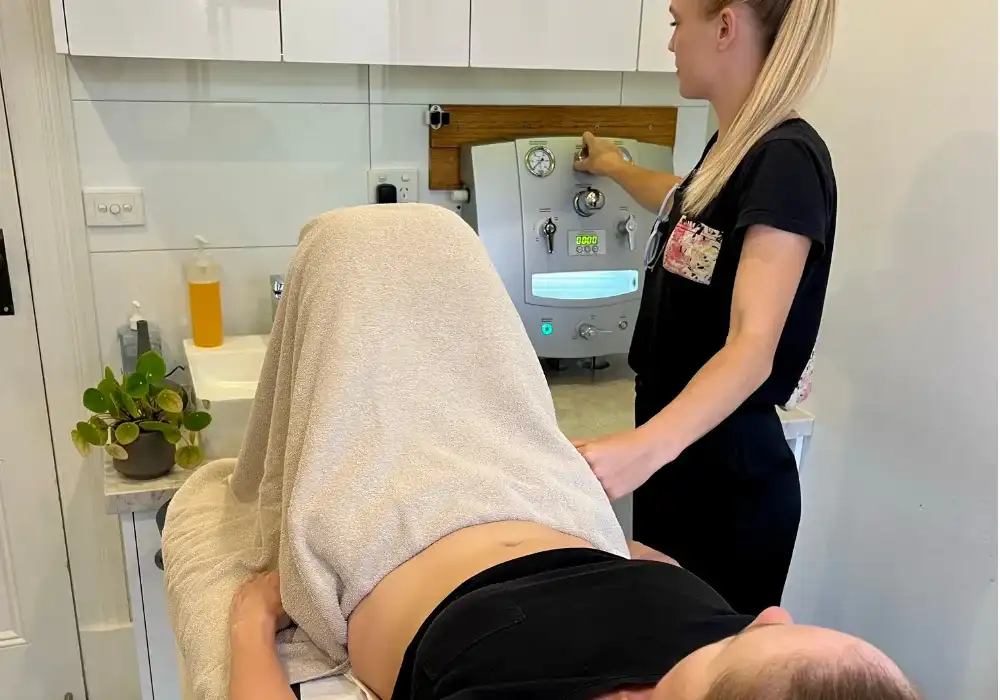
If you’ve looked into colonic hydrotherapy, you’ve probably come across the terms “closed system” and “open system” without much explanation of what they actually mean. The difference matters more than most marketing copy lets on. It affects your privacy, hygiene, comfort and how closely a practitioner is involved in your session.
What is an open system?
An open system uses gravity-fed equipment, typically with the client lying on a table with a small tube inserted and waste flowing out via an open channel into a basin or drain, often visible during the session. In many open-system clinics, the practitioner sets you up and then leaves the room, checking in periodically rather than being present throughout.
What is a closed system?
A closed system uses a sealed tube arrangement, water flows in and waste flows out through the same sealed connection, with nothing visible or exposed during the process. Pressure, flow rate and temperature are set by a trained practitioner using the equipment’s controls and adjusted continuously as the session goes, so the treatment is shaped around how your body is responding rather than running at a fixed rate for 40 minutes.
The two systems side by side
| Closed system | Open system | |
|---|---|---|
| Who’s in the room | A practitioner, for the whole session | Usually sets you up, then leaves |
| Water pressure | Machine-regulated, adjusted live | Gravity-fed, depends on tank height |
| Water temperature | Regulated automatically | Not actively controlled |
| Where waste goes | Sealed line, never exposed to the room | Open basin beneath the table |
| Odour and splashback | None | Likely |
| The viewing tube | Interpreted for you as it happens | Nobody watching it |
| Getting set up | Done for you | You insert and manage it yourself |
| Abdominal massage | Available where it helps | Not possible, nobody there |
| Best suited to | Anyone, including first-timers and more complex health histories | Confident, self-directed repeat clients |
The one question worth asking any clinic: who is in the room, and who is controlling the water pressure? Nearly everything else about closed versus open follows from the answer to that.
Why we only use closed systems
We use closed-system equipment exclusively, for a few concrete reasons:
- Hygiene, nothing is exposed to the air at any point during the procedure, which is both more comfortable and more hygienic than an open setup.
- A treatment tuned to you, pressure, flow and temperature are adjusted the moment something needs changing, so the session tracks your body instead of a preset. That’s the difference between tolerating a colonic and getting a good result from one.
- Privacy, a sealed system in a private room with its own ensuite, with the equipment handled for you, tends to feel considerably less exposing than setting yourself up in an open setup.
This is medical equipment, not spa equipment
Here’s something most clinics never mention: colonic irrigation machines are regulated medical devices in Australia.
They have to be entered on the Australian Register of Therapeutic Goods, the ARTG, before anyone can legally supply them here. That register is public, and you can search it yourself, for example, the Axent Medical colonic irrigation kit appears as ARTG entry 311467.
These are Class IIa devices, the Therapeutic Goods Administration’s category for low-to-moderate risk equipment. Being on that register means the device has been assessed. It’s a real bar to clear.
Why does this matter to you? Because it gives you something concrete to ask about. If you ring a clinic and ask what machine they use and whether it’s ARTG-listed, a good clinic will tell you straight away. A vague answer tells you something too.
Yes, doctors use colon irrigation too
Colon irrigation isn’t only a wellness treatment. It has a recognised medical use: clearing the bowel before a procedure such as a colonoscopy.
That’s the use the equipment is formally cleared for overseas as well. Under the US rules (21 CFR 876.5220), a colonic irrigation system is approved as a Class II device when it’s used for “colon cleansing when medically indicated, such as before radiological or endoscopic examination.”
There’s published research behind this. Studies have looked at colon irrigation as a way to prepare the bowel for colonoscopy, including as a back-up option when the standard oral prep hasn’t worked well enough. Others have examined colon cleansing devices in people with chronic constipation.
So this isn’t a fringe idea. It’s an established technique with a legitimate clinical role.
But we’ll be straight with you about the limits. Those same US rules put devices meant for “colon cleansing routinely for general well being” into a stricter category, not a looser one. In other words, regular wellness colonics face more scrutiny than pre-procedure cleansing does. If a clinic tells you doctors endorse routine detox colonics, they’re stretching it. We’d rather you heard that from us.
Why water pressure is the whole safety question
A modern closed-system machine controls water pressure precisely and regulates temperature automatically. That isn’t a comfort feature. That is the safety mechanism.
An open, gravity-fed system has nothing equivalent. The water pressure depends simply on how high the tank sits above you, and nobody is watching it during your session. If you’re also alone in the room, the only thing standing between you and a problem is your own ability to notice it and do something about it.
For a fit, healthy adult, that’s usually uneventful.
But if someone has a heart condition, reduced kidney function, diverticular disease, or a more fragile bowel, being left unmonitored stops being a theoretical concern. They may not recognise the early signs of a problem, and there’s no one there to recognise it for them. That’s exactly why we treat a supervised closed system as non-negotiable for older adults.
What this means for you
If you’re comparing clinics, it’s worth asking directly whether they use a closed or open system, whether the device is a cleared Class II medical device, and whether a qualified practitioner controls and adjusts the treatment for the full session, not just sets you up at the start. All three are reasonable questions to ask of any clinic, not just this one.
Our answer to all three is on the page describing the colonic irrigation we provide in Brunswick West.
Ready to see the difference for yourself? Book online or read more about what to expect at your first visit.
Check it yourself
We’d rather you verified this than took our word for it. These are the primary sources:
Australian government
- Therapeutic Goods Administration, device classification, what Class IIa actually means
- Australian Register of Therapeutic Goods, search any medical device supplied in Australia
- healthdirect, constipation, plain-English advice, including when to see a doctor
- Better Health Channel, bowel cancer, the Victorian Government’s guide to symptoms and risk factors
- National Bowel Cancer Screening Program, free home testing, now from age 45
Regulation overseas
- 21 CFR 876.5220, the US rule defining what colonic irrigation systems are approved for
Published research
- Colon hydrotherapy as a rescue option for inadequate bowel preparation before colonoscopy
- A mechanical colon cleansing device in people with chronic constipation
- Chronic constipation in older adults: a primer for the gastroenterologist
If anything on this page doesn’t match what you find, we want to know, email us and we’ll correct it.
Frequently asked questions
Which is better, an open or closed colonic system?
For most people a closed system is the better choice, because a practitioner stays in the room to regulate pressure, adjust flow and interpret what passes through the viewing tube in real time. Open systems are self-administered with the client usually alone, which means no monitoring and no feedback. We only use closed systems.
Is an open system colonic unsafe?
Not inherently, but the safety margin depends almost entirely on water pressure, and an open system leaves that unmonitored. With no practitioner present to notice discomfort or adjust the flow, problems that a closed system would catch early can go unnoticed. That's the core of the difference.
Does a closed system colonic smell?
No. In a closed system waste passes from the tube directly into a sealed waste line without ever being exposed to the room, so the session is odourless. Open systems release waste into an open basin beneath the table, where odour and splashback are likely.
Do doctors use colonic irrigation?
Yes. Colon irrigation is used in hospital settings for bowel preparation before colonoscopy and in the management of faecal incontinence and severe constipation. The equipment involved is medical equipment rather than spa equipment, which is part of why operator training matters so much.
Ready to book your appointment?
No referral needed. Book online 24/7, or call reception.
Still weighing it up?